Amigurumi for Beginners: How to Crochet Your First Toy
Start amigurumi with confidence: supplies, magic ring, spiral rounds, increases and invisible decreases, stuffing, safety eyes and assembling your first toy.
By Ayoub Farid · · 4 min read
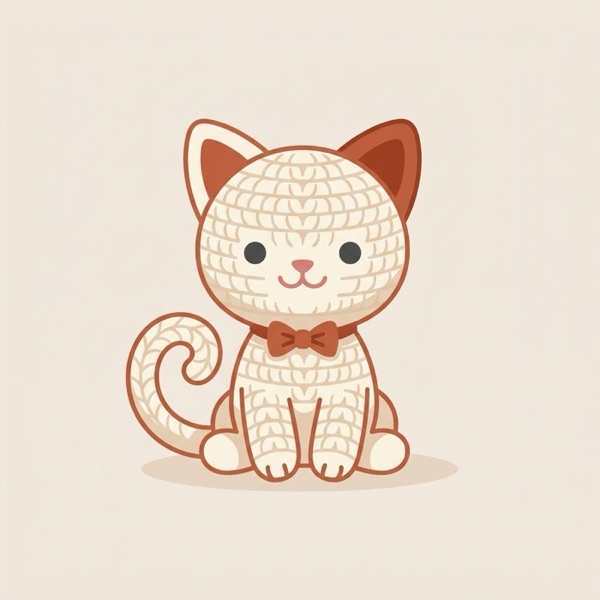
Amigurumi (from the Japanese for "knitted/crocheted stuffed toy") is the art of crocheting small stuffed creatures: bears, cats, dragons, fruit, vegetables, anything with a cute face. It looks intricate, but most amigurumi uses just one stitch: single crochet, worked in a spiral.
If you can single crochet, you can make amigurumi. Here's everything you need for your first one.
Supplies
- Yarn: smooth acrylic or cotton in worsted or DK weight. Avoid fuzzy yarn while learning; it hides stitches.
- Hook: one or two sizes smaller than the yarn label suggests, e.g. 3.5–4 mm for worsted. Tight stitches keep the stuffing from showing.
- Stitch marker: essential for marking the first stitch of each round.
- Fiberfill stuffing.
- Safety eyes (6–12 mm), or embroider the eyes with yarn.
- Tapestry needle and scissors.
The 5 amigurumi techniques
1. The magic ring
Almost every amigurumi piece starts with 6 sc in a magic ring, pulled tight so there's no hole.
2. Spiral rounds
Amigurumi is usually worked in continuous spirals: you don't join at the end of each round. Instead, place a stitch marker in the first stitch of each round and move it up as you go. This avoids a visible seam.
3. Increases (inc)
Two sc in the same stitch. Increases make a piece wider. Six increases per round, evenly spaced, make a flat circle.
4. Invisible decrease (inv dec)
Insert the hook into the front loop only of the next stitch, then the front loop of the following stitch (3 loops on hook). Yarn over, pull through 2 loops, yarn over, pull through the last 2. It's much less visible than a standard sc2tog.
5. Working even
Sc in each stitch around, with no increases or decreases. The piece grows straight up, like a tube.
How shapes are made
Every amigurumi shape is a sequence of these:
| Shape | Recipe |
|---|---|
| Ball (head) | Increase to the widest point, work even, decrease back |
| Cylinder (arm, leg) | Small start, then work even |
| Cone (ear, horn) | Increase very gradually |
| Oval (body) | Increase, work even longer, decrease |
Example: a simple ball
| Round | Instructions | Stitches |
|---|---|---|
| 1 | 6 sc in magic ring | 6 |
| 2 | inc in each st | 12 |
| 3 | (sc, inc) × 6 | 18 |
| 4 | (sc 2, inc) × 6 | 24 |
| 5–9 | sc in each st | 24 |
| 10 | (sc 2, dec) × 6 | 18 |
| 11 | (sc, dec) × 6 | 12 |
| — | Stuff firmly | — |
| 12 | dec × 6 | 6 |
Fasten off, thread the tail through the front loops of the last 6 stitches and pull closed. That ball is the base of a head, a fruit or a Christmas ornament.
Stuffing and safety
- Stuff firmly but not so much that the stitches stretch open. Add stuffing in small pieces.
- Place safety eyes before closing the piece. Snap the washer on from the inside; it won't come off.
- Toys for babies and toddlers under 3: safety eyes and small parts can be a choking hazard. Embroider the eyes and features with yarn instead, and sew all parts on very securely.
Assembling your toy
- Pin all pieces in place before sewing, then check the look.
- Sew with the yarn tail and a tapestry needle, going through both pieces in small stitches around the edge.
- Embroider details (nose, mouth, cheeks) last.
Beginner-friendly amigurumi
- A ball or fruit (no assembly)
- Small vegetables like a carrot or a radish
- A simple cat or mouse with sewn-on ears
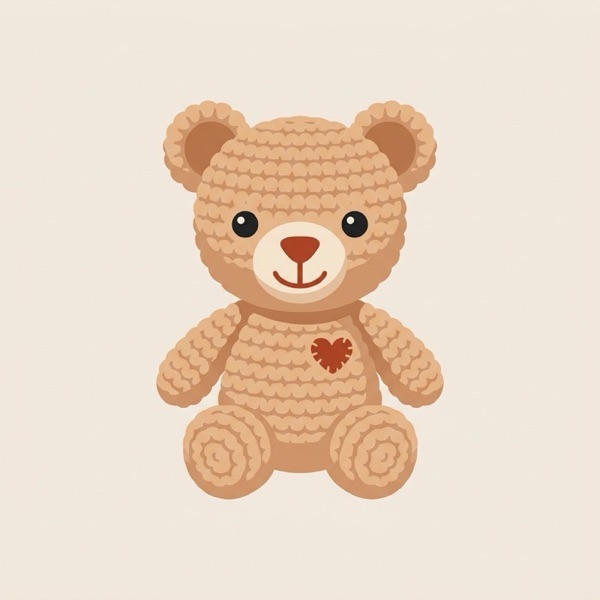
- A mini bear (your first multi-part toy)
Try it in HookWise
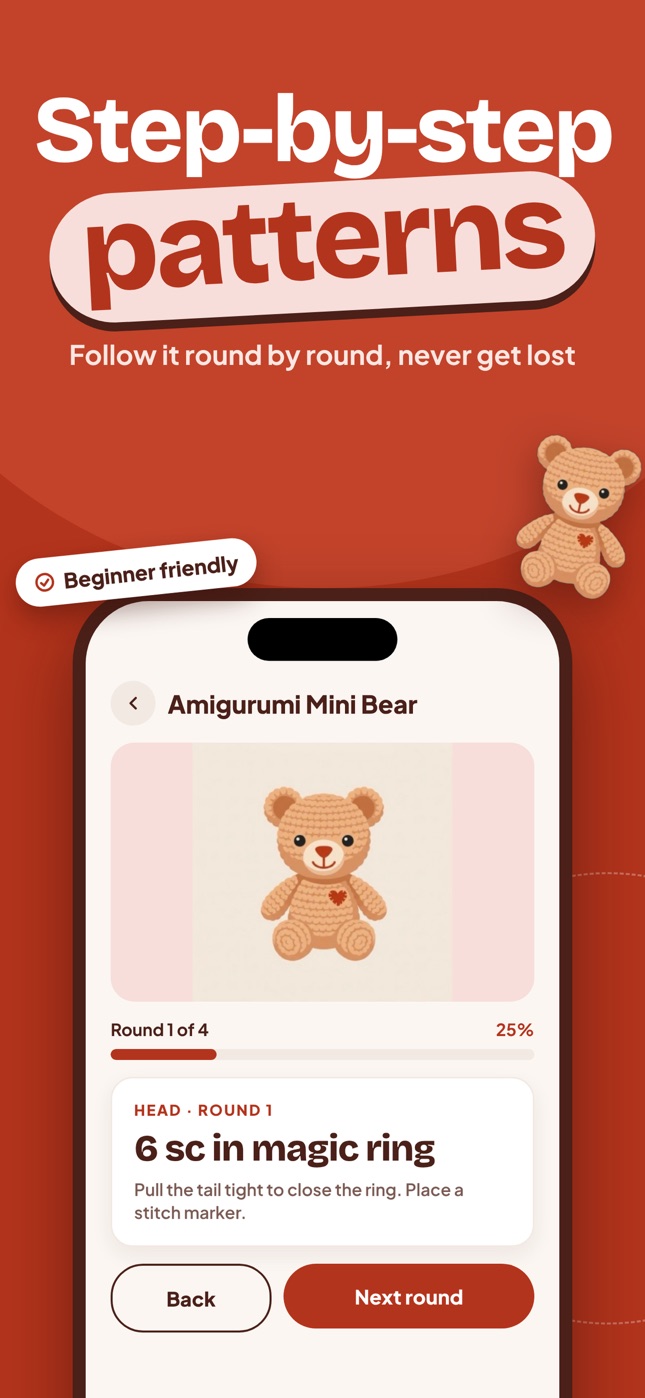
HookWise includes several amigurumi patterns, from small fruits and vegetables to a cat, a mini mouse, a dragon and the Amigurumi Mini Bear, whose first round is exactly "6 sc in magic ring". Each round is shown with its stitch count, which is ideal for amigurumi, where one missed stitch changes the shape.
Frequently asked questions
Is amigurumi good for beginners?
Yes, if you're comfortable with single crochet. Start with a ball or a one-piece shape before toys with many sewn-on parts.
Why can I see the stuffing through my amigurumi?
Your stitches are too loose for the yarn. Use a hook one or two sizes smaller than the yarn label recommends.
What yarn is best for amigurumi?
Smooth acrylic or cotton in worsted or DK weight. Cotton gives crisp stitch definition; acrylic is soft and inexpensive.
Do I join rounds in amigurumi?
Usually not. Most amigurumi is worked in continuous spirals with a stitch marker in the first stitch of each round. Follow your pattern if it says otherwise.
Crochet with a coach in your pocket
Learn to crochet with HookWise
94 step-by-step patterns that save your place, AI stitch & yarn identification from one photo, and an AI helper for when you get stuck. Free to download on iPhone.
Free on iPhoneDownload on the App Store