Crochet Stitch Identifier: How to Identify Any Stitch
Identify a crochet stitch from a photo with AI, or by eye: what to look for in height, texture and shape, plus a visual guide to the most common stitches.
By Ayoub Farid · · 5 min read
You've seen it: a cardigan with rows of little fans, a blanket with a woven look, a hat with raised ridges. You want to make it, but you don't know what the stitch is called, so you can't even search for a pattern.
There are two ways to identify a crochet stitch: ask an AI stitch identifier from a photo, or learn to read the fabric yourself. The best approach is both: let the app give you a name, then confirm it with your own eyes. This guide covers each.
Method 1: Identify a stitch from a photo with AI
Stitch identifier apps use an image model trained to recognize crochet textures. You take or upload a photo, and the app returns the most likely stitch name, often with extra details such as yarn weight and a suggested hook.
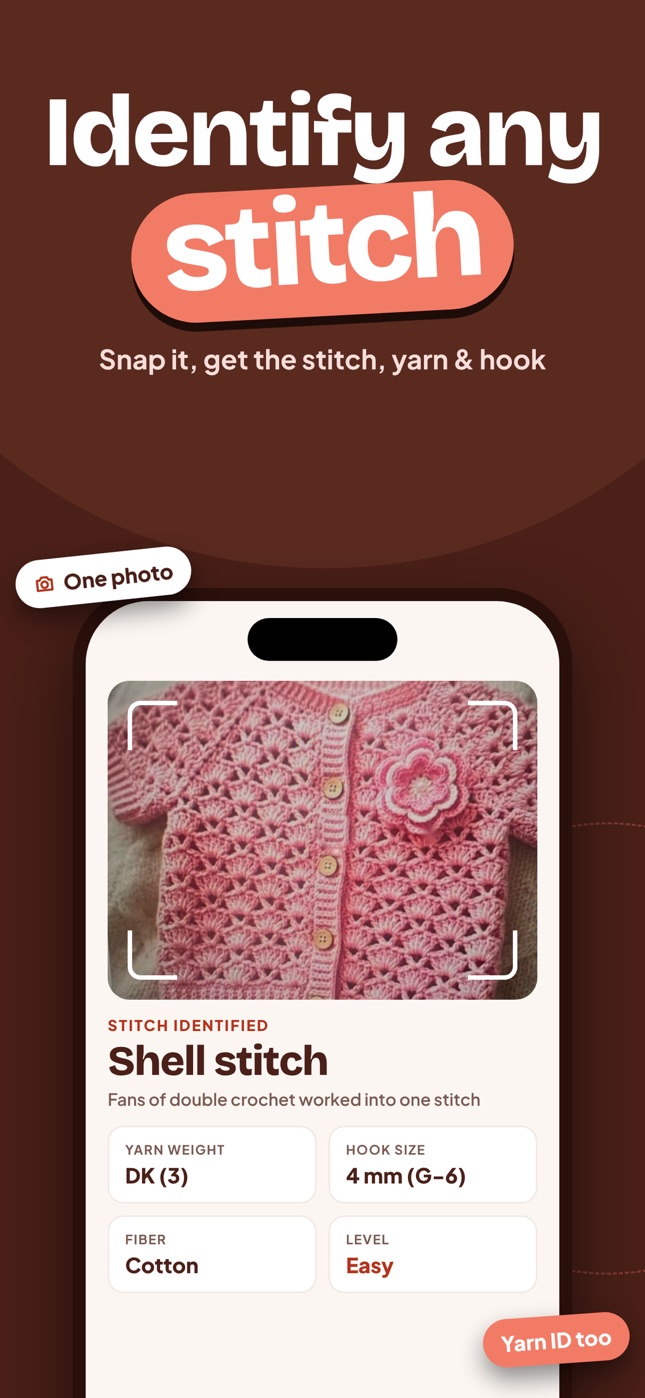
In HookWise, one photo returns the stitch name, a one-line description, an estimated yarn weight, fiber and hook size, and a difficulty level.
How to take a photo that gets a good result
- Fill the frame with the stitch pattern, not the whole garment. Six to ten repeats is ideal.
- Use soft daylight next to a window. Harsh flash flattens texture; dim light blurs it.
- Shoot straight on, not at an angle. Angles distort stitch height, which is a key clue.
- Lay the piece flat on a contrasting background (light yarn on a dark surface, dark yarn on a light one).
- Avoid stretched areas like seams, edges and ribbing, unless the ribbing is what you want identified.
What AI stitch identifiers can and can't do
They are very good at common, well-photographed stitches: single crochet, double crochet, granny clusters, shell, V-stitch, moss (linen) stitch, puff and bobble. They struggle with:
- Fuzzy or very dark yarn, where individual stitches are hard to see.
- Combinations of several stitches in one piece. The app may name only the dominant one.
- Knitting that looks like crochet (and vice versa). Tunisian crochet especially can look knitted.
- Rare or designer stitches, which may be reported as the nearest common stitch.
Treat the result as an expert's first guess. Then confirm it with the checks below and a small swatch.
Method 2: Identify a crochet stitch by eye
Every crochet stitch is built from the same moves, so you can narrow down any stitch with four questions.
1. Is it crochet or knitting?
Knitting forms neat columns of little V shapes. Crochet forms knots and posts, and the fabric is usually thicker and less stretchy. If you see rows of tiny Vs stacked vertically, it's probably knit (or Tunisian crochet).
2. How tall are the stitches?
Compare the height of a single row to its width:
| Stitch | Height | Look |
|---|---|---|
| Single crochet (sc) | About as tall as wide | Dense, tight little knots |
| Half double crochet (hdc) | Medium | Extra horizontal bar under the top loops |
| Double crochet (dc) | About twice sc | Tall posts with gaps between them |
| Treble crochet (tr) | Tallest common stitch | Long posts, open and lacy |
If you know the basic stitches, everything else is a combination. See our guide to basic crochet stitches.
3. Are stitches grouped?
- Fans of 5 or so tall stitches from one point: shell stitch.
- Groups of three tall stitches with spaces between: granny stitch, as in a granny square.
- Two tall stitches in a V with a chain between: V-stitch.
- Puffy round bumps on one side: puff, bobble or popcorn stitch.
4. Is the texture flat, ridged or woven?
- Woven, like fabric: moss stitch (also called linen or granite stitch), made of single crochet and chain 1 alternating.
- Raised vertical ridges: front and back post stitches, as in ribbing or a waffle stitch.
- Horizontal ridges on every row: working in the back loop only (BLO).
- Little diagonal blocks: corner-to-corner (C2C), built from small groups of double crochet.
Quick reference: common stitches at a glance
| What you see | Probably |
|---|---|
| Fans or scallops | Shell stitch |
| Clusters of 3 in a grid | Granny stitch |
| Woven look, tiny holes | Moss / linen stitch |
| Bumpy 3D squares | Waffle stitch |
| Thick ribbing on a hat brim | Front & back post double crochet |
| Puffy rows | Puff stitch |
| Pixel-like diagonal blocks | C2C |
| Dense, firm, small knots | Single crochet |
After you've identified the stitch
- Search with the stitch name and the item: "shell stitch baby cardigan pattern" works far better than "pink crochet sweater".
- Match the yarn weight. The same stitch in DK and bulky yarn produces very different fabric. See our yarn weight chart.
- Make a swatch of at least 10 × 10 cm (4 × 4 in) before starting the real piece, and check gauge.
Try it in HookWise
HookWise's stitch & yarn scanner works from a single photo and gives you the stitch name, estimated yarn weight, fiber and hook size together, so you can go straight to a matching pattern in the library. If the result surprises you, ask the built-in AI helper why, and it will explain what to look for.
Frequently asked questions
Is there an app that identifies crochet stitches?
Yes. Several apps now use AI to identify crochet stitches from a photo. HookWise identifies the stitch and also estimates yarn weight, fiber and hook size from the same photo.
How accurate are crochet stitch identifiers?
They are reliable for common stitches photographed clearly in good light, and less reliable for fuzzy yarn, very dark colors and unusual or combined stitches. Always confirm with a small swatch.
How can I tell if something is knitted or crocheted?
Knitting shows neat columns of V shapes and is usually stretchier. Crochet shows knots and upright posts, and the fabric is thicker. Tunisian crochet can look knit-like but is worked with a long crochet hook.
Can AI identify the yarn too?
It can estimate yarn weight and likely fiber from texture and scale, which is a useful starting point. For certainty, check the yarn label or use the tests in our yarn identification guide.
Crochet with a coach in your pocket
Learn to crochet with HookWise
94 step-by-step patterns that save your place, AI stitch & yarn identification from one photo, and an AI helper for when you get stuck. Free to download on iPhone.
Free on iPhoneDownload on the App Store